Triumph of Conservatism by Gabriel Kolko
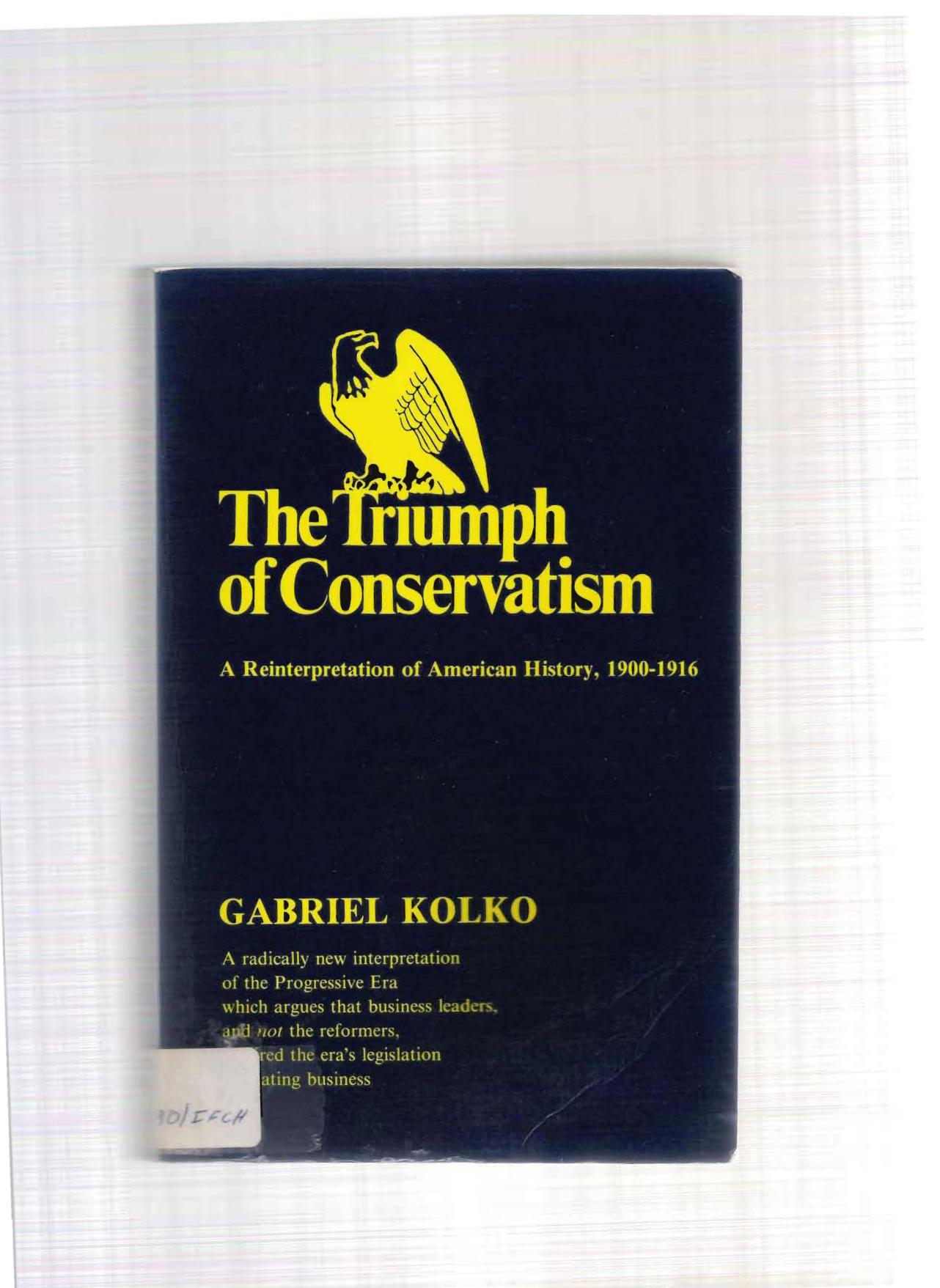
Author:Gabriel Kolko
Language: eng
Format: epub, mobi, pdf
Publisher: Simon & Schuster
Published: 1963-10-06T04:00:00+00:00
The Banking Reform Movement
The panic of 1907 exposed the basic weaknesses in the nation’s banking structure, and no one was more aware of the fact than the bankers. But the bankers had shown themselves to be hopelessly divided on legislative matters and incapable of agreeing on any plan to stabilize interest rates and price levels and to reduce fluctuations—to introduce the much vaunted and poorly defined elasticity necessary for a national, profitable banking system.
Despite these divisions, the banking community—or at least that small portion of it that thought about such matters—was more seriously aware of the need for banking reform than ever before. Only through reform, Henry Clews declared, could the responsible, conservative bankers and businessmen be protected from the follies of the irresponsible few. But the alternatives were diverse, very diverse, and given the hostility of the House, the disunity among bankers tended to nullify their larger desire for banking reform. Although the majority of bankers favored some type of centralization of decisionmaking and greater elasticity of currency, their differences on the type of backing for a more elastic currency, or the form and control of the centralization, seemed insurmountable.34 The Republican platform of 1908, reflecting the split in the banking community, merely endorsed banking reform in the broadest and vaguest terms. Taft, like Roosevelt, was bound to very little.
Nelson Aldrich still remained the key figure in politics concerned with banking reform. His close relationship with Taft on other issues was a crucial asset, but his reputation among Insurgents and Democrats was that of a blackguard conservative, and it seemed unlikely that Aldrich alone could have any measure passed. Moreover, Aldrich had strong feelings on banking reform that were not, according to such sympathetic associates as Paul Warburg, based on even a technically sound knowledge of banking principles. Aldrich’s deficiencies were more than compensated for, however, by the many able and sophisticated individuals around him, and after he took his National Monetary Commission to Europe to study banking systems there, Aldrich quickly educated himself in the field. More important, Aldrich was soon to realize that his prominent association with the banking reform cause was a political liability, and he was anxious to play a somewhat less conspicuous role, at least so far as the public’s view of the movement was concerned. Aldrich’s associates, aware of the entire issue of public relations, also reiterated the need to avoid associating banking reform with Wall Street, even though Wall Street was the heart of the movement, if legislation was ever to be attained.
Aldrich’s European tour convinced him of the virtues of central banking and the desirability of a broader-based asset currency utilizing sound commercial paper as well as gold, bonds, and other extremely restricted reserves. This change made it possible for Aldrich, whose 1907 and 1908 schemes had been roundly opposed by the American Bankers Association, to appeal to a much wider audience in the banking community. Indeed, Aldrich ceased being a sectarian on banking reform and was able from 1909 on,
Download
Triumph of Conservatism by Gabriel Kolko.mobi
Triumph of Conservatism by Gabriel Kolko.pdf
This site does not store any files on its server. We only index and link to content provided by other sites. Please contact the content providers to delete copyright contents if any and email us, we'll remove relevant links or contents immediately.
| Africa | Americas |
| Arctic & Antarctica | Asia |
| Australia & Oceania | Europe |
| Middle East | Russia |
| United States | World |
| Ancient Civilizations | Military |
| Historical Study & Educational Resources |
Cat's cradle by Kurt Vonnegut(15441)
Pimp by Iceberg Slim(14662)
4 3 2 1: A Novel by Paul Auster(12505)
Underground: A Human History of the Worlds Beneath Our Feet by Will Hunt(12144)
The Radium Girls by Kate Moore(12089)
Wiseguy by Nicholas Pileggi(5841)
The Fire Next Time by James Baldwin(5501)
Perfect Rhythm by Jae(5459)
American History Stories, Volume III (Yesterday's Classics) by Pratt Mara L(5337)
Paper Towns by Green John(5247)
Pale Blue Dot by Carl Sagan(5076)
A Higher Loyalty: Truth, Lies, and Leadership by James Comey(5017)
The Mayflower and the Pilgrims' New World by Nathaniel Philbrick(4540)
The Doomsday Machine by Daniel Ellsberg(4538)
Killers of the Flower Moon: The Osage Murders and the Birth of the FBI by David Grann(4488)
The Sympathizer by Viet Thanh Nguyen(4440)
Too Much and Not the Mood by Durga Chew-Bose(4386)
The Borden Murders by Sarah Miller(4375)
Sticky Fingers by Joe Hagan(4251)
